
Executive Summary
Most organizations do not have a risk problem.
They have a coordination problem.
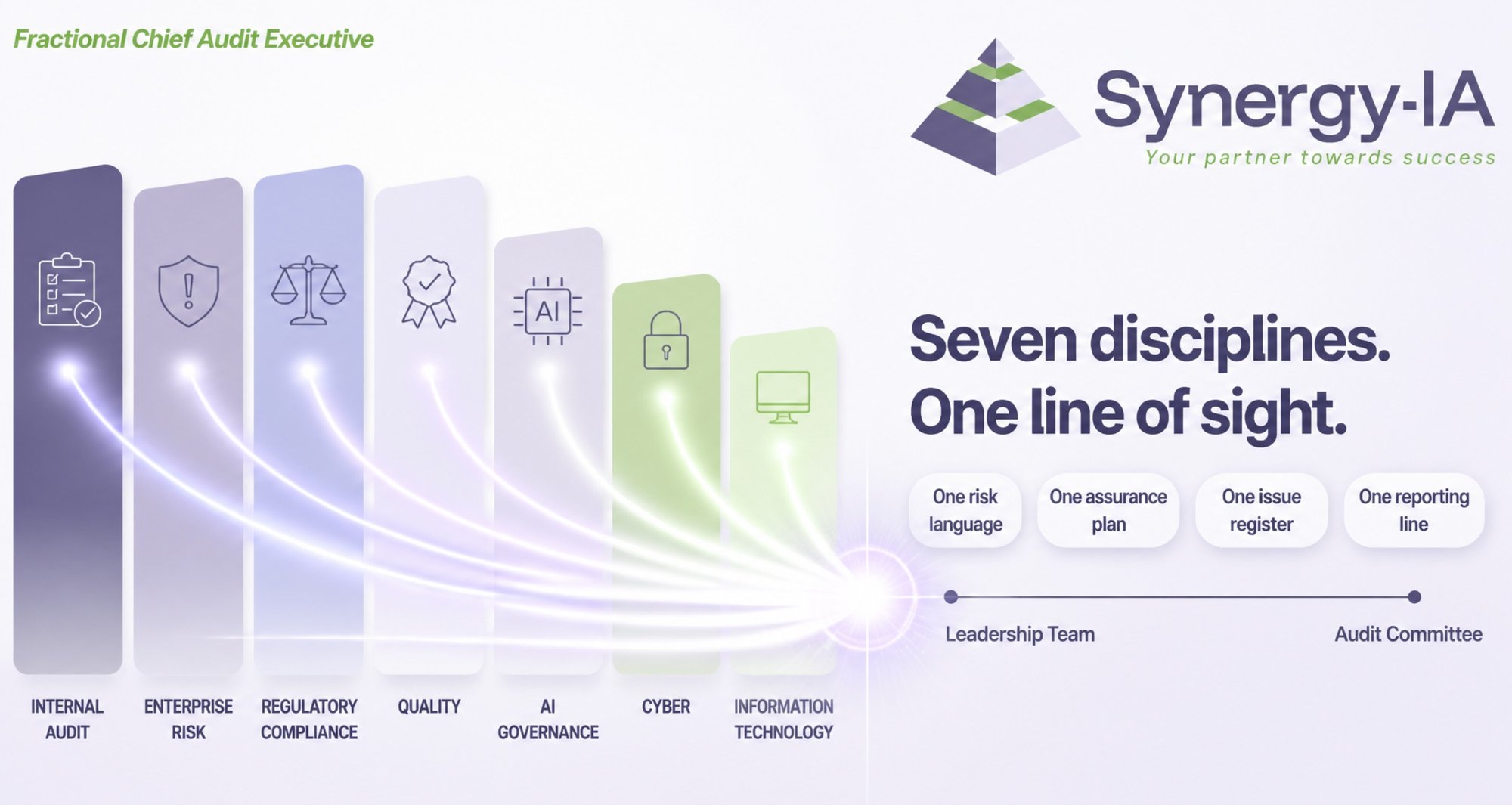
Seven functions — Internal Audit, Risk Management, Regulatory Compliance, Quality, AI Governance, Cyber, and IT, each produce credible work in isolation; each uses its own risk language, rating scales, issue logs, and reporting cadence.
The result is expensive duplication, contradictory severities, findings that never close, and Boards that receive a stack of polished reports instead of one prioritized view of what could actually stop the strategy.
Our answer is a fractional Chief Audit Executive who runs one integrated assurance operating model:
- One risk language: A shared taxonomy, rating scale, and heat map used identically by audit, risk, compliance, AI, cyber, IT, and quality.
- One assurance plan: Coverage allocated across every assurance provider so nothing material is tested twice and no material is missed.
- One issue register: Any finding from any function is tracked to closure with one accountable owner, and one agreed due date.
- One reporting line: A single consolidated, prioritized assurance report to the Audit Committee and Leadership Team, with independence preserved exactly as the IIA Global Internal Audit Standards require.
This page sets out what we believe is broken, the mistakes our profession keeps repeating, the uncomfortable truths buyers and decision-makers work around, how specialty firms like Synergy-IA can differentiate, precisely what a fractional CAE must deliver to each stakeholder group, the five risks that matter most right now in Q&A form, and how to measure performance — including the red flags that should make you worry.
Better Assurance, Better Decisions: What Leadership Teams and Boards Deserve to Know
What Is Wrong with How GRC Engagements Are Executed Today
This article explains why internal audit, risk management, regulatory compliance, quality, AI governance, cybersecurity, and IT assurance often fail to produce a single reliable view of organizational risk. It argues that the core problem is not a lack of frameworks or capable teams, but fragmented assurance, duplicated testing, weak ownership, and reporting structures that prevent leadership teams, boards, and external auditors from seeing one combined picture of exposure. Across seven domains, the piece shows how assurance activity drifts toward production rather than reliance, then makes the case for integrated assurance built on shared ownership, coordinated coverage, and evidence strong enough to support real governance decisions. Read more
The Mistakes Practitioners Repeat — And What You Should Hold Them Accountable For
Internal audit mistakes often repeat when organizations treat audit as a compliance task rather than a leadership function. This article explains the most common practitioner mistakes — including weak risk alignment, poor stakeholder communication, unclear independence, and limited follow-through. Read More
The Uncomfortable Truths Stakeholders Work Around
Stakeholders often work around uncomfortable governance truths when internal audit signals are unclear, delayed, or easier to ignore than address. This article explores the patterns behind that behavior and explains how stronger audit leadership helps organizations surface risk earlier, improve accountability, and strengthen decision-making. Read More
How a Specialty Internal Audit Advisory Firm Differentiates
A specialty internal audit advisory firm differentiates itself by providing senior-led judgment, stronger governance alignment, and focused expertise that generalist firms often cannot match. This article explains the qualities that set these firms apart and why that difference matters for audit committees, CFOs, and organizations facing complex risk and compliance demands. Read More
What a Fractional Chief Audit Executive Must Deliver — By Stakeholder
A fractional Chief Audit Executive must deliver different forms of assurance to different stakeholders, from board independence and executive risk insight to portfolio comparability and external audit reliance. This article explains what each group should receive and why the real measure of a strong fractional CAE is building a standards-aligned audit function that outlives the engagement. Read More
The Five GRC/Audit Risks That Matter Most — Practical Q&A
The most important Internal Audit, Risk Management and Regulatory Compliance risks are the ones that most directly affect governance strength, regulatory exposure, and decision-making under pressure. This practical Q&A explains five priorities the Leadership Team should focus on and how stronger oversight helps organizations address them before they become larger control or compliance problems. Read More
Measuring and Monitoring Internal Audit’s Performance — And the Red Flags
This post explains how to measure internal audit (assurance) performance in a way that reflects real risk reduction rather than activity alone. It introduces a four-part framework built around coverage, timeliness, outcomes, and behavior, then shows the red flags that signal weak assurance, compromised independence, duplicated effort, and ineffective remediation. For boards, audit committees, management teams, and external auditors, the piece offers a practical way to judge whether an internal audit function is producing decision-grade assurance or simply reporting effort. Read More
Fractional CAE Engagement Models, Onboarding, and Independence
This article explains how Fractional Chief Audit Executive engagements are structured, how onboarding works in the first 90 days, and how independence is protected in practice. It outlines five engagement models, defines the deliverables organizations should expect by days 30, 60, and 90, and states the governance boundaries that preserve objective assurance, clear Audit Committee reporting, and proper separation of advisory work. For leadership teams, Audit Committees, and external audit partners, the piece provides a practical framework for evaluating whether an assurance model is truly built to deliver integrated, board-ready oversight rather than a loosely defined retainer. Read More
Can a single fractional CAE really cover audit, risk, compliance, AI, cyber, IT, and quality?
No: Any firm that says otherwise is selling coverage it cannot deliver.
The fractional CAE owns the integrated model: the taxonomy, the plan, the register, and the reporting, and personally delivers the audit and assurance work.
For deep technical domains such as cyber, AI model testing, and specialized regulatory regimes, we bring in named specialists and coordinate their coverage rather than duplicating it. The value is in the coordination and the accountability, not in pretending one person is seven.
Will this duplicate what our external auditor already does?
It is designed to do the opposite. Mapping coverage explicitly and building a function that meets the standard for external reliance reduces duplicate testing — the objective PCAOB AS 2605 contemplates when it directs the external auditor to consider the work of internal audit
How is this different from hiring a full-time CAE?
Cost and flexibility, not capability. You get a senior CAE's judgment and accountability for a fraction of the fully loaded cost, and you can scale the engagement down as the function matures — or scale it up during a remediation or exit. What you do not get is someone sitting in your office every day; if that is what you need, the interim model applies.
How quickly will we see value?
Three things should be visible within 30 days: a consolidated issue register with real owners and dates, a duplication and gap analysis, and an honest statement of exposure in AI, cyber, and ICFR. The first consolidated assurance report to the Audit Committee is typically delivered in the first 90 days.
What does 'one risk language' mean in practice?
A single taxonomy of risk categories, one rating scale with written definitions of likelihood and impact, and one heat map that every function populates. In practice, this means a risk rated 'high' by the quality function means the same thing as 'high' by cyber, audit, or compliance — so the Board can compare and prioritize.
Does integrating the functions undermine our independence?
Coordination is not the same as consolidation of accountability. The IIA's Three Lines Model explicitly calls for collaboration and communication across the lines to avoid unnecessary duplication, overlap, or gaps, while preserving the governing body's oversight of internal audit and the CAE's independent reporting line.
Combined assurance is defined precisely as internal and external parties coordinating their activities to communicate the effectiveness of risk management.
Independence is protected by who owns the conclusion and where the reporting line runs, not by how much the functions talk to each other.
We are private and not subject to SOX. Does any of this apply?
Yes, but the emphasis changes. Privately held and public-sector organizations face the same failure modes — duplication, unclosed findings, unmanaged AI, untested resilience — without the regulatory forcing function that makes public companies address them. Private organizations typically adopt the model for financial-institution or customer requirements, for exit readiness, or because a loss event made the exposure undeniable.
What if we already have most of these functions established?
Then the engagement is a design and uplift exercise: we integrate what exists rather than build from scratch, and we can hand over a functioning model rather than a dependency.
