
How a Specialty Internal Audit Advisory Firm Differentiates

Information Synergy-iA
How a Specialty Internal Audit Advisory Firm Differentiates
6:53
Why a Specialty Internal Audit, Risk Management, and Regulatory Compliance (GRC) Advisory Firm Is Not a Smaller Version of a Large One
Most stakeholder conversations and concerns we encounter start from the same place: three audiences, three sets of anxieties, one shared question.
- The C-suite/Leadership Team asked whether another layer of assurance would produce decisions or just deliverables.
- The Board asked a different question — not whether the work is being done, but whether we can rely on the conclusion when it arrives, and whether we can tell advice apart from independent judgment.
- The External Audit Partner asked the question that quietly governs the other two: is this function reducing the risk that matters, or is it generating documentation that makes everyone feel covered?
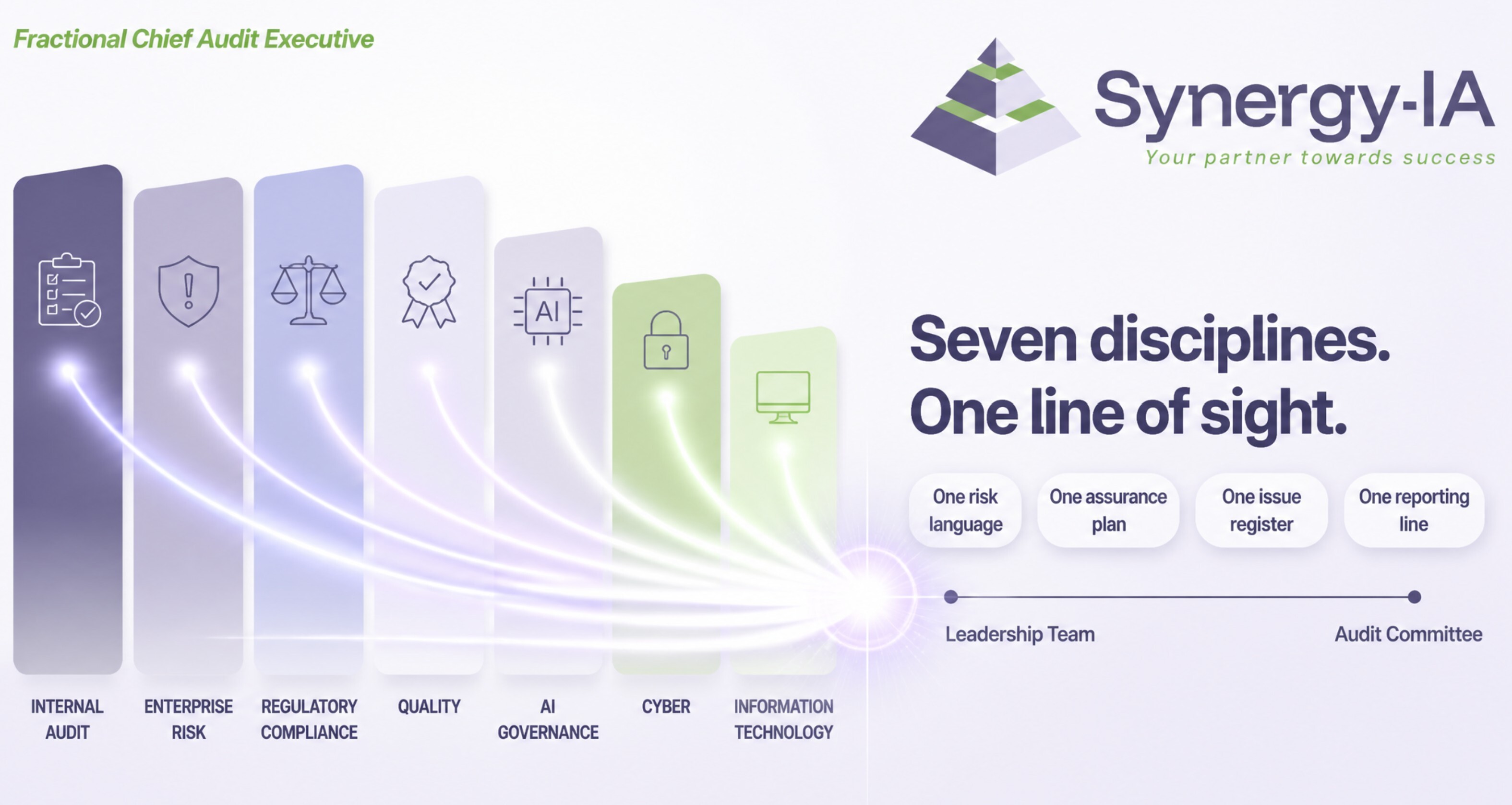
Those questions do not sit comfortably on one page, which is precisely why they belong together. They are all symptoms of the same structural problem: assurance is usually assembled from fragments, a review here, a mandate there, a template applied everywhere — and then presented as if the fragments add up to a whole. They rarely do. Each fragment answers the same underlying question in a different, non-comparable way, and nobody can say with confidence which material risk is covered by whom.
Synergy-IA was built to answer that problem rather than to compete on scale. We are not a large firm with fewer people. We are a different model: a small number of senior practitioners, accountable by name, delivering one integrated assurance model that other providers plug into rather than duplicate.
This section sets out plainly, and with the trade-offs left visible — what that model does differently, and where it is genuinely the wrong answer.
|
The big-firm default |
The risk of that default |
The specialty-firm alternative |
|
Engagement teams of juniors, rotated annually, briefed by the partner |
Institutional memory leaves with the team; you pay to re-teach context |
The practitioner who designs the model delivers it — no rotation, no re-briefing |
|
Function-by-function mandates (an IA review, a risk review, a compliance review) |
Each buys a separate, non-comparable answer to the same question |
One mandate covering an integrated assurance model that other providers plug into |
|
Methodology applied as a template, with documentation prioritized over evidence |
Deliverables optimized for defensibility rather than decision quality |
Evidence-first, with the minimum documentation the IIA Standards require and no more |
|
Independence asserted in the proposal, challenged in practice |
Second-line scope creep creates non-audit work that compromises objectivity |
Independence safeguards written into the charter and reviewed at each engagement boundary |
|
Coverage assumed from headcount |
Duplication and gaps hidden by the sheer volume of work |
Coverage mapped explicitly so every material risk has exactly one accountable assurance provider |
|
Advisory and assurance blended into one workstream |
The Board cannot distinguish advice from independent conclusion |
Strict separation: assured matters are tested and reported; advisory opinions are labeled as such |
|
Cost justified by FTE-hours |
Costs grow with headcount, independent of risk |
Fractional model priced against retained risk and the decisions it protects |
The Entire Product Is the Willingness to Say It
Read the table above again and the last column as a set of promises rather than a set of preferences. Then read the middle column as the risk you are currently carrying if none of those promises are made to you by name.
The seven rows describe one idea from seven angles: the person who designs the assurance model delivers it, and that person is accountable to the Board in person. No rotation means context does not have to be re-taught. One integrated mandate means answers are comparable. Evidence-first means the deliverable is built for decisions rather than for defensibility. Written safeguards mean independence is a documented commitment, not an assertion. Explicit coverage mapping means gaps and duplication are visible rather than averaged out. Separation of advisory from assurance means the Board can tell which of the two it is reading. A fractional model means cost tracks retained risk rather than deployed headcount.
Three further differentiators matter in practice:
- The Synergy-IA Fractional CAE approach makes economic sense for organizations that cannot justify a full-time Chief Audit Executive and cannot tolerate operating without one;
- the same model serves as a transitional CAE for private-equity-backed businesses preparing for exit, or as the independent function a smaller public company needs after a material weakness; and most importantly,
- we are willing to say the uncomfortable thing — first to the Leadership Team, to avoid surprises, and then in the Audit Committee meeting. That is the whole point. Everything else is the mechanism.
Three questions to ask any practitioner before you engage them
- Who will actually deliver the work you are proposing, and will that person still be on my engagement in year three? Ask for the name, not the firm. Ask what happens if that individual leaves, who carries the institutional memory, and how the handover is documented. A team assembled around you each cycle is a different product from a named practitioner under a multi-year mandate, and the proposal should say which one you are buying.
- Show me where independence is written down, and show me what you have declined to keep it. Independence asserted in a proposal is a claim; independence written into the charter, with restricted non-audit work and a documented review at each engagement boundary, is a control. The follow-up question matters more than the first: what work have you turned away because it would have placed you on both sides of the same conclusion?
- When you find something the Leadership Team would rather not hear, what is the sequence — and will the Audit Committee hear it from you directly? Ask for the escalation path: what goes to management first, in what timeframe, in what form, and what happens if management disagrees with the finding. A function that only reports what it can get endorsed is a reporting channel, not an assurance provider. The willingness to be uncomfortable in the room is the product.
If the answers are specific, evidenced, and uncomfortable to give comfortably, you are speaking to an assurance provider. If they are general, reassuring, and immediately agreeable, you are speaking to a firm selling hours.
To learn more about Synergy-IA or our Fractional CAE Services, email us at information@synergy-ia.com