
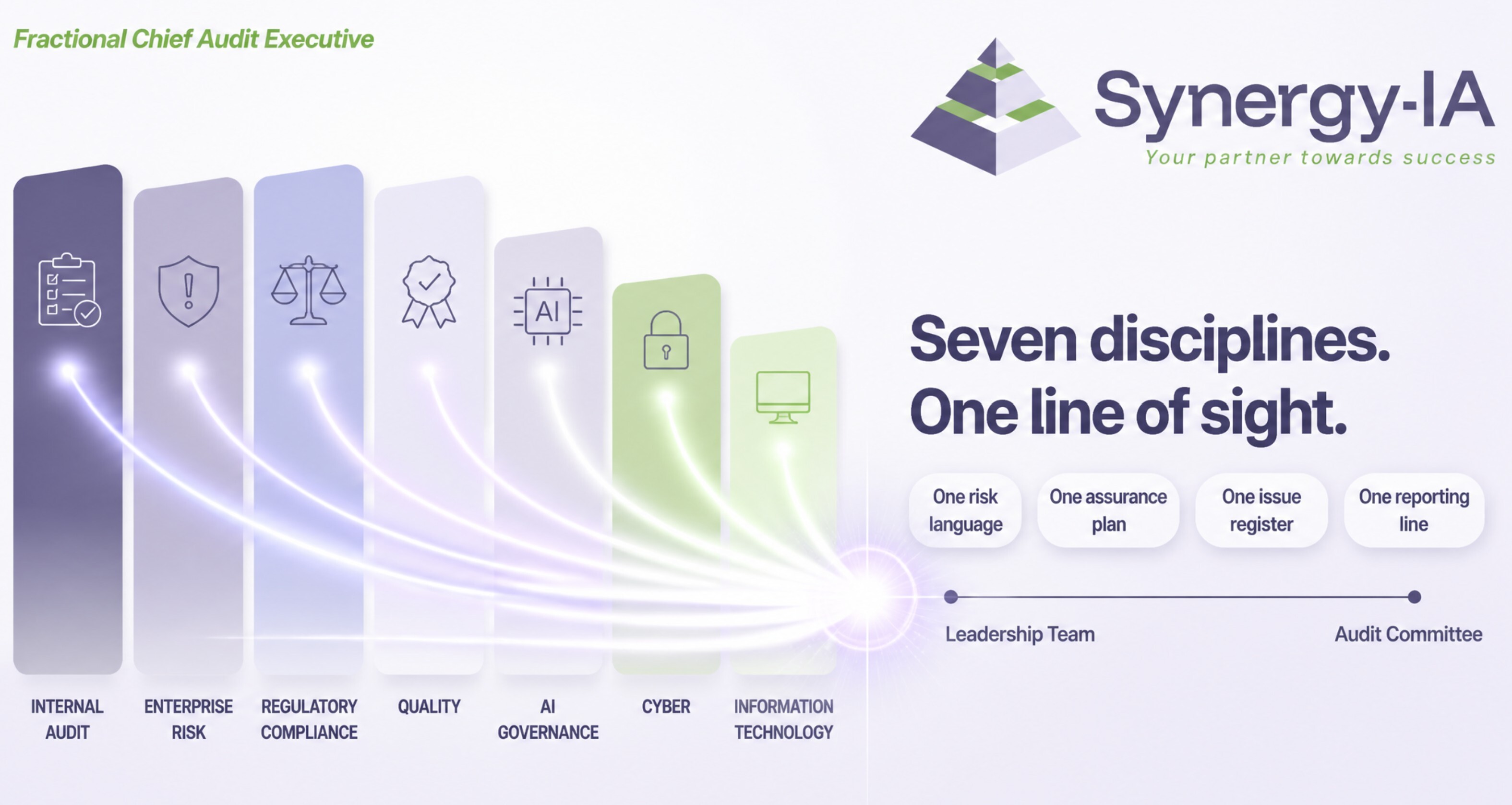
What a Fractional Chief Audit Executive Must Deliver — By Stakeholder

Information Synergy-iA
What a Fractional Chief Audit Executive Must Deliver — By Stakeholder
9:46
The Fractional CAE: One Mandate, Four Stakeholders, Four Different Reports
Most mid-market and sponsor-backed companies have no internal audit function. They typically have a single experienced person, or a co-sourced rotation that changes shape every year, holding a mandate that their Leadership Team or Board has never fully written down.
That is the gap the Synergy-IA fractional Chief Audit Executive (CAE) fills. But 2025 and 2026 changed what "filling it" means. The IIA's Global Internal Audit Standards became mandatory on 9 January 2025, restating the purpose, governance, and quality obligations across five domains, fifteen principles, and fifty-two standards, including a sharper requirement that the audit committee governs the function and that the CAE's reporting relationship runs to it. Regulation moved in the same window: DORA's ICT risk and third-party oversight obligations took effect on 17 January 2025; the SEC's Item 106 puts a company's cyber risk-management processes, board oversight, and management expertise into the annual report; and both ISSA 5000, the sustainability assurance standard, and the revised ISA 240 on fraud apply for periods beginning on or after 15 December 2026.
At the same time, the function is being squeezed. The Internal Audit Foundation reported in March 2026 that internal audit teams are being asked to do more with less — flat budgets against a wider mandate. And the IIA's Risk in Focus research shows a specific kind of exposure: cybersecurity remains the top-ranked risk worldwide, while digital disruption, including AI, ranks second at 58% and rose by 10 percentage points in a year, with high severity, low maturity, and frequently no named owner for the assurance.
As such, fractionalization is not primarily a cost story. It is a capability story: buy the senior judgment, the standards conformance, and the reporting line, without buying a permanent full-time department before the function has earned one.
A fractional CAE who hands the Board, the C-suite/Leadership Team, the Private Equity Operating Partner, and the External Audit Partner the same quarterly deck is not communicating. They are distributing. Each of those four groups is testing a different claim about the function:
|
Stakeholder |
The claim they are actually testing |
|
Board / Audit Committee |
Is this an independent voice I can rely on when management is optimistic? |
|
Leadership Team (C-suite) |
Will this reduce risk and bureaucracy, or add to both? |
|
PE Operating Partners |
Does assurance convert into value, comparability, and a defensible exit? |
|
External Audit Partners |
Can I rely on this function, and does it shorten my audit? |
The same evidence base. Four different products.
The sections that follow set out what each audience must receive, not aspirational descriptions of internal audit, but deliverables a buyer can hold a practitioner to. This is a practitioner's view, drawn from the standards, regulators, and published market evidence cited throughout. Where an item is an expectation rather than a rule, it is described as such. Below is what each group must receive.
1. To the Board and Audit Committee
- One consolidated assurance report, produced quarterly, that states the current residual risk position by domain and names the three risks whose realization would most damage strategy.
- An independent, unmediated reporting line: the CAE's primary reporting relationship is to the Audit Committee, including hiring, resourcing, and performance of the internal audit function — the expectation set out in the IIA's Three Lines Model.
- Direct assurance over the things the Committee is personally exposed to: material weakness remediation, going-concern-adjacent control health, cyber and AI risk framing, whistleblowing and ethics, and the quality of what management reports upward.
- An external quality assessment and internal quality assurance program that satisfies the Global Internal Audit Standards — including the new requirement set effective January 2025.
- A short 'what we are worried about' section, written by the CAE, disagreeing with management if necessary.
The IIA Three Lines Model - https://www.theiia.org/globalassets/documents/resources/the-iias-three-lines-model-an-update-of-the-three-lines-of-defense-july-2020/three-lines-model-updated-english.pdf
The IIA Global Internal Audit Standards - https://www.theiia.org/en/standards/2024-standards/global-internal-audit-standards/
2. To the Leadership Team (C-suite)
- A risk-based assurance plan that is genuinely aligned to the operating plan: capital projects, acquisitions, system implementations, new products, and regulatory commitments — not a rotation list.
- One issue register with one owner and one due date per finding, so an executive is never asked to close the same underlying problem twice under two different names.
- A reduction in the burden on the first line: fewer, better-targeted requests, with assurance providers coordinating rather than re-testing. Audit fatigue from duplicative second- and third-line testing is a documented, measurable cost.
- Clear, upfront criteria for findings and severity, agreed before fieldwork, so close-out meetings are not negotiations.
- Practical, decision-ready insight: what to do, what it costs, what happens if you do nothing, and by when.
Deloitte Observations - https://www.deloitte.com/us/en/services/consulting/articles/modernizing-the-three-lines-of-defense-model.html
3. To Private Equity Operating Partners
- A diligence-grade baseline within the first 30–60 days: what is the true state of internal control, compliance, cyber, and finance-function hygiene across the deal perimeter.
- A credible value-creation instrument: assurance findings converted into an EBITDA-relevant remediation roadmap with costed, dated actions.
- Exit readiness: an ICFR and control environment that withstands buyer due diligence and, for a public exit, the scrutiny of a registration statement.
- Portfolio-level comparability: one risk language and one scoring model across portfolio companies so the operating partner sees a true consolidated view rather than incompatible scorecards.
- Independent escalation for issues that portfolio management may be motivated to understate — including fraud indicators, revenue recognition, and vendor concentration.
- A cost model that scales down after stabilization instead of a permanent full-time headcount.
4. To External Audit Partners
- A reliable, independent internal audit function whose work can be considered and, where permitted, relied upon under PCAOB AS 2605, reducing duplicate testing and improving efficiency.
- Evidence of a competent, objective, appropriately resourced function: charter, independence safeguards, methodology, supervision, and quality assurance — the factors the standard directs the external auditor to evaluate.
- Early visibility of control deficiencies before they become audit adjustments or a material weakness finding. Material weaknesses remain concentrated in documentation gaps, insufficient accounting resources, and process weaknesses.
- A single control matrix and a single issue register that the external team can work from, rather than reconciling three versions of the same population.
- Clean separation between direct assistance (delivered under the external auditor's direction, where permitted) and independent internal audit work, so reliance is defensible.
The PCAOB AS 2605 - https://pcaobus.org/oversight/standards/auditing-standards/details/as-2605-consideration-of-the-internal-audit-function_1528
The Real Deliverable Is a Function That Outlives the Engagement
Read the four sections together, and a pattern emerges. The Board is buying independence. The C-suite is buying relief. The private equity operating partner is buying a value instrument and a defensible exit. The external audit partner is buying reliance. None of them is buying "audit reports" as such. That has an uncomfortable implication for how fractional engagements are sold.
- A practitioner who optimizes for the volume of findings, or the longevity of the retainer, is optimizing against all four of those buyers.
- Findings with no owner and no date are noise.
- Assurance that duplicates second-line testing is a cost.
- A function the external auditor can't rely on means the work gets done twice.
- And a fractional CAE who never documents a methodology is not building a function — they are renting one out indefinitely.
The clearest test of a fractional CAE is therefore not what they produce in year one. It is whether, in year two or three, a permanent CAE, or a different provider, could step into a functioning department with a charter, methodology, risk-based plan, single issue register, quality assurance program, and Standards conformance position already in place. If that handover is impossible, the engagement has become a dependency.
The honest corollary is that the best fractional engagements end. Ideally with a permanent CAE who inherits a standard-compliant function, or with a smaller, cheaper, better-targeted mandate. Buyers should treat that as a feature, and price it in.
To learn more about Synergy-IA or our Fractional CAE Services, email us at information@synergy-ia.com